Attribute Magazine: Showcase the Positive and Unique Attributes of Individuals, Businesses and Organ
This was the official website of Attribute Magazine. The content below is from the site's 2008 archived pages.
I enjoyed reading Attribute Magazine when it was still live online. I particularly liked reading their Arts & Entertainment section. Style and fashion is my thing. And I certainly have scrutinized Lachi's style over the years. I was able to catch Lachi as an opening act at the Music Hallin Williamsburg way back in 2008. A great show in a really perfectly sized space. Fourteen years later Lachi is now well established. She has evolved to become not only a singer songwriter, composer, producer, but also an actress, author, disability advocate and cultural activist based in New York City. Likewise hers tyle has changes, as has mine. I now shop at ElegantWigs.com since they offer higher end, but still well priced for their quality wigs for black women. Extensions is not their thing, However the availability of styles in a multitude of lengths, made from synthetic fibers, heat friendly / heat defiant / heat resistant fibers, human hair, or blends of heat friendly / human hair, gives me loads of options. Most pics of Lachi (circa 2022) she's wearing beautiful braided extensions. I went through a phrase wearing elaborate braids, but now I only go to the expense and time they require when its a special event. For my everyday professional look I am now into wigs that are full of glorious well-behaved curls which can be styled in smooth spirals or fluffed for a softer, fuller effect. Curl Appeal by Gabor is one such style that I have received a lot of compliments. Sassy Curl by Hairdo, a sexy, sassy mane of tight, touchable coiled ringlets that fall just above the shoulders is another as is Diva by Rene of Paris. I love the Diva in Cream de Coco, silver white blonde with a dark brown base/ roots. Hello Targaryen blonde with a twist!
Well I digress. I'm going to miss checking into Attribute Magazine, but all things in life must evolve and move on.
About Us
Written by Administrator | Friday, 04 July 2008 - 23:51:50
attribute: (n) something attributed as belonging to a person, thing, group, etc.; a quality, character, characteristic, or property.

Our Mission:
To showcase the positive and unique attributes of individuals, businesses and organizations to the betterment of society and the world:
• What is it that drives us?
• What is it we contribute and are passionate about?
• Who we are, what we consume, where we play, work, live, etc…
Who are we?
• attribute magazine’s staff is comprised of a talented, intelligent team of individuals who have come together to give independent, global media, a voice-one unlike any other.
• Our writers attract and hold the attention of our growing readership by offering a voice of truth, of empowerment, understanding, optimism and intelligence
What are we?
• attribute magazine is an independently owned, Internet based publication, which means we only publish digital editions.
• We adhere to sustainable business practices therefore will never produce a paper product.
• We provide a readily available, global platform for our readers.
When?
• Articles updated weekly and monthly
• Editor’s blog updated frequently
• Live on the web 24/7/365
Where?
• Online at www.attributemagazine.com and we have a presence on all major social networking sites.
Why?
• Because we passionately feel it is time for the world to have an outlet to use its “outside” voice: attribute magazine is a place for community, values and encouragement among the movers, shakers and thinkers of the world.
How?
• With lots of hard work and perseverance, attribute magazine came to fruition as a labor of love by its founding staff and contributing writers. We have a heart.
• attribute magazine features informative, thought provoking and entertaining articles for everyone. Share us with your family, friends and colleagues.
• Sustainably! We practice, utilize and encourage sustainable/green business practices.
attribute magazine….using our “outside” voices.
+++
Arts and Entertainment - Music
Lachi Traversing Expectations
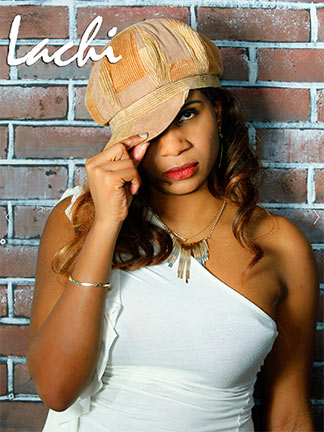 Lachi is a vocalist, songwriter, composer, multi-instrumentalist and author based in New York City. Having released numerous albums and singles, Lachi's music is often described as Pop, Dance, or Singer Songwriter.
Written by Marissa Yeamans | Wednesday, 16 June 2010
This life has no shortage of obstacles and setbacks, but most of us have the luxury of at least being in possession of all five basic physical senses. But even to be denied one of those senses doesn’t equate to a diminished experience of life, and could actually add to it. One young woman has proven that it’s not what you’ve got on the outside, but the life and the power you have on the inside that primarily determines the quality of your life.
Lachi is a highly active, gifted, singer/songwriter and musician based in New York City, and is the front-woman of and the creative force behind the band Lachi. The distinguishing attribute of the band is the fact that every member is blind. But don’t put Lachi and her band in the “blind musician box” a la Stevie Wonder or Ray Charles. She accepts her blindness, but isn’t hindered by it. And she accomplishes quite a lot in the process.
“Though these eyes are broken, well, these ears truly see right...in black and white,” reads a quote from the band’s Facebook page. As one of seven children growing up in Maryland, Lachi was born with a low visual impairment, Coloboma of the retina, which left her legally blind. She describes herself as a “quiet child” and says her blindness “shaped a lot of my songwriting.” She continued, “I grew up as a bit of a shut-in. I would lock myself in my room and write songs. Music really has always been a close part of me, like my diary.” After her mother noticed she was inclined to music, she bought Lachi a keyboard.
Lachi then began to develop her musical and writing skills, admiring such artists as Radiohead, the Smashing Pumpkins, Bjork, Fiona Apple, Regina Spektor, The Beatles, and Ella Fitzgerald. Throughout her school years, she continued writing and performing both vocal and piano pieces, and wrote and published her first novel, Dante’s Destiny, before she graduated high school in 2001.
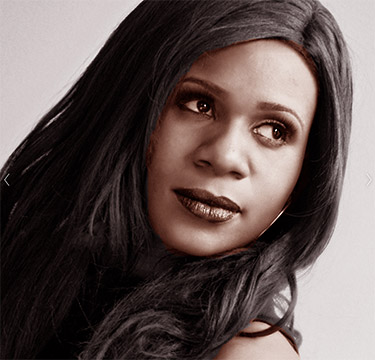
Lachi describes herself as having grown up from a “shy childhood to a world-traveling adulthood”, although she never let either the shyness or her blindness ultimately hinder her from developing her musical abilities and exploring the world. The musical expression she enjoyed eventually became the vehicle through which she would grow more whole and confident.
After earning her Master’s degree in Music Technology at New York University in 2008, she had more free time and started to become more serious about her music. A short time later, she got the band together, with Lachi herself on vocals and keyboards, Andre Donatien on guitar, Jamie Diaz on bass and Jimmy Fontanez on drums. Later in 2008, they started doing shows around New York City. “It wasn’t easy to get people to come out to see us,” she remembers, “but things picked up after we got out there awhile and people started to see that we really rocked. We started to meet other blind musicians at that time and ended up playing up with a bunch of visually impaired guys. Lots of people started digging it, and it started creating a lot of buzz.”
Her music has been described as “jazz-influenced, piano-driven alternative rock”. It exudes a classy, funky, and fresh sound, with implications of a rock-jazz blend and sometimes spiced with a delicate sultry flavor. The subject matter of her lyrics is multi-dimensional and predominantly optimistic, exploring themes of self-discovery, blindness, inner beauty, and overcoming adversity. She and her band have performed at numerous music festivals, including SXSW, CMJ, and the IndieGirl Conference. They continue to receive attention from the college, local, and online radio stations.
In addition to her own music, Lachi has reached out into the blind community of New York City and become involved in BEAM NYC Blind Entertainers Artists and Musicians of NYC., an organization devoted to bringing blind musicians together and helping to promote them. “There are lots of blind musicians in New York City,” she explains. “We came together and created a collective of blind music, and we go around and do showcases together. Yes, we’re blind, but we can play music and we rock like everybody else. People come and see that we rock, and that helps them move past the blindness.”
Lachi is very passionate about that message, as illustrated both through her words and lyrics, as well as shown in her energetic performances. She doesn’t treat her blindness as a disadvantage. “Some out there don’t want to associate with their blindness, but we feel why not? We can’t hide it. We can’t be angry about it. So we just embrace it. It’s not a handicap at all, and doesn’t need to be seen that way,” she states. “Honestly, probably our biggest stumbling block is that it’s not as easy to get somewhere, but we’ve got a lot of support from the New York community. It’s really wonderful.”
Simultaneously, she also hopes to dispel stereotypes and presumed disadvantages about blindness and show that it doesn’t need to be approached delicately, treated “differently”, used as a crutch, nor does it contribute to diminished capabilities. “Not every blind musician is sitting around a piano with dark glasses. We want to eliminate that myth and all those stereotypes. A lot of that is simply innocent ignorance, but we want to contribute to helping people to become just a little more open about it, and hope to get it spread nationwide, and even worldwide.”
You can hear Lachi and her band rock out on her upcoming self-titled album, LACHI, which will be released through Fanatic Records on July 27th. It is already available for preorder at www.amazon.com. “I’m excited for people to hear the new album,” she beams. “It’s got lots of personal songs. It’s about self-discovery, acceptance of insecurities; no songs about hate. It’s uplifting, it rocks, and we want people to jump on board.”
Lachi regularly performs in New York City, as well as occasionally in other areas of the country, including the upcoming PrideFest in Milwaukee on June 12 where she and her band will open for Patti LaBelle. She is available on several social media pages and various websites, including Youtube and iTunes, where you can listen to tracks, watch her music videos, check out her tour schedule, and find more information: